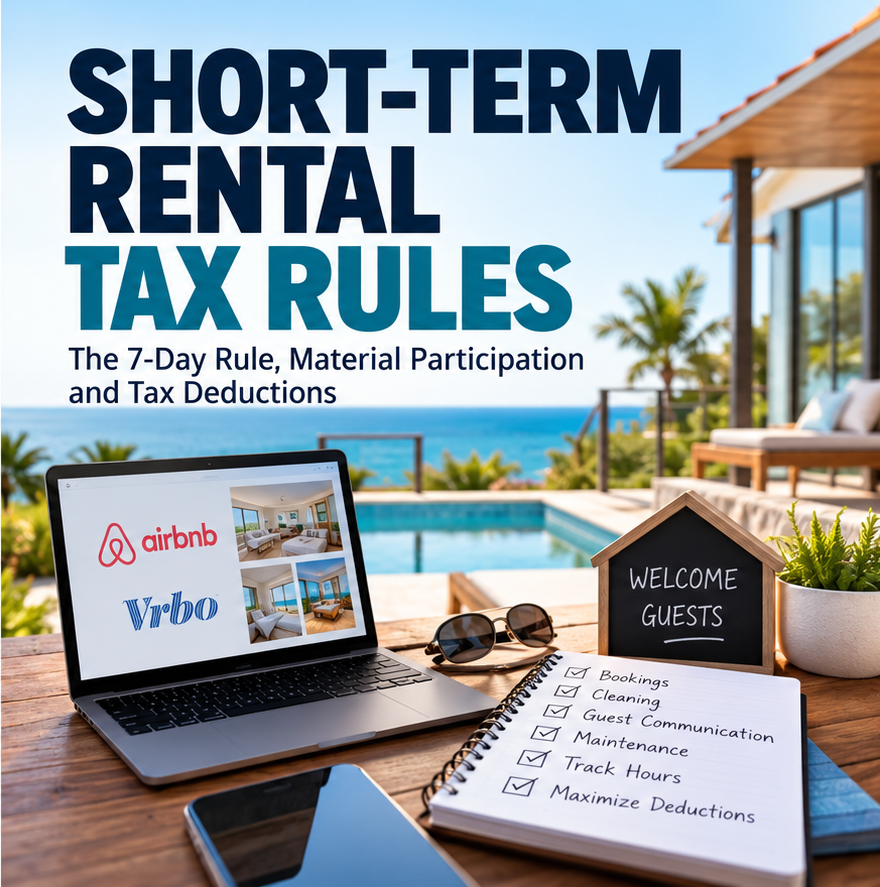
Short-term rental properties, including those listed on Airbnb and VRBO, can offer tax planning opportunities that differ significantly from traditional long-term rentals.
One of the most important differences is that certain short-term rentals are not classified as rental activities under the IRS passive activity rules.
This distinction may allow qualifying property owners to deduct losses against wages or other nonpassive income without qualifying as a real estate professional.
However, owning a short-term rental does not automatically make its losses deductible.
The IRS 7-Day Rule
Under the IRS passive activity rules, an activity generally is not considered a rental activity when the average customer stay is seven days or less.
The average is calculated by dividing the total number of days in all customer rental periods by the number of rentals during the tax year.
For example, if a property has 40 reservations totaling 240 rental nights, its average customer stay is six days.
This may allow the property to fall outside the passive activity rules that automatically apply to most traditional rental real estate.
Importantly, this does not mean the property is automatically nonpassive. The owner’s material participation must still be evaluated.
What About the 30-Day Rule?
Another exception may apply when the average customer stay is 30 days or less and the owner provides significant personal services in connection with the rental.
Whether services are significant depends on their nature, frequency, and value. Routine repairs, common-area cleaning, and other services typically associated with traditional rentals generally do not satisfy this requirement on their own.
Material Participation: How Many Hours Are Required?
A qualifying short-term rental may generate nonpassive income or losses if the taxpayer materially participates in the activity.
The IRS provides seven alternative material participation tests. You generally need to satisfy only one applicable test.
| Test | General requirement |
|---|---|
| 1 | Participate more than 500 hours during the year. |
| 2 | Your participation constitutes substantially all participation in the activity, including work performed by nonowners. |
| 3 | Participate more than 100 hours, and no other individual participates more than you. |
| 4 | Participate in multiple qualifying significant participation activities for more than 500 combined hours, subject to specific rules. |
| 5 | Materially participate in the activity in any five of the preceding ten tax years. |
| 6 | Materially participate in a qualifying personal service activity in any three preceding tax years. This test generally does not apply to ordinary property rental operations. |
| 7 | Participate regularly, continuously, and substantially under the facts and circumstances, with more than 100 hours and additional restrictions. |
The 100-Hour Test
For many short-term rental owners, the third test is particularly relevant.
You must participate more than 100 hours during the year, and no other individual may participate more than you.
For example, an owner who spends 150 hours managing a short-term rental may qualify under this test if no cleaner, property manager, maintenance worker, or other individual spends more time participating in that activity.
Paid contractors count when comparing the participation hours of other individuals.
The 100-hour test is not satisfied merely because you work more hours than your property manager. You must also consider the participation of everyone else involved.
Which Hours Count?
Activities that may qualify include:
- Communicating with guests and coordinating reservations
- Personally cleaning and preparing the property
- Performing maintenance and repairs
- Managing day-to-day property operations
- Coordinating cleaning and maintenance services
- Purchasing and replenishing supplies as part of operations
However, time spent solely reviewing investment performance, studying potential acquisitions, or performing activities in an investor capacity generally does not count.
Travel time and activities undertaken primarily to manufacture participation hours also warrant careful consideration.
Maintaining detailed records of your activities throughout the year is important.
Do You Need Real Estate Professional Status?
No, not necessarily.
For qualifying short-term rental activities that fall outside the IRS definition of rental activity, taxpayers may be able to establish nonpassive treatment through material participation without satisfying the 750-hour real estate professional test.
This can be especially relevant to taxpayers who work full-time in another profession.
However, short-term rentals with longer average stays or different operating arrangements may be subject to the traditional rental real estate rules.
Learn more about Real Estate Professional Status and the 750-Hour Rule → real-estate-professional-status
Cost Segregation and Bonus Depreciation
Some short-term rental investors use cost segregation studies to identify building components that qualify for shorter depreciation recovery periods.
Depending on the property, eligible assets may include certain appliances, furnishings, equipment, and land improvements.
Qualifying assets may also be eligible for bonus depreciation under applicable tax law.
These deductions can generate substantial tax losses, but whether those losses can offset other income depends on material participation and other tax limitations.
Accelerated depreciation also affects future tax calculations, including potential depreciation recapture when the property is sold.
A cost segregation study should therefore be evaluated as part of a longer-term tax plan, rather than solely for an immediate deduction.
Personal Use of Your Short-Term Rental
If you personally use a vacation rental, additional rules may limit deductible expenses and losses.
Special vacation home rules can apply when personal use exceeds the greater of 14 days or 10% of the property’s fair-market rental days.
The IRS also has separate rules for properties rented fewer than 15 days during the year.
Owners should track personal-use days and rental days separately, including stays by family members and certain discounted rentals.
Schedule E or Schedule C?
Not every short-term rental belongs on Schedule C.
Many short-term rentals are reported on Schedule E, even when the activity is treated as nonpassive under the material participation rules.
Schedule C generally becomes relevant when substantial services are provided primarily for guests’ convenience, similar to services offered by hotels.
The reporting classification can also affect self-employment tax treatment.
The average guest stay and material participation tests alone do not determine which schedule applies.
Documentation Matters
Short-term rental owners should maintain:
- Reservation reports showing guest arrival and departure dates
- Detailed participation records and calendars
- Cleaning and maintenance schedules
- Contractor invoices and records
- Receipts for operating expenses and improvements
- Records of personal-use days
- Depreciation schedules and property acquisition documents
Accurate records help establish both the rental’s classification and the taxpayer’s level of participation.
Watch Our Video: Real Estate Professional Status vs. Short-Term Rentals
Our video explains the basic differences between traditional rental real estate professional requirements and short-term rental tax rules.
Short-Term Rental Tax Planning With AFSG Consulting
Short-term rentals can provide valuable tax planning opportunities, but the rules depend on more than simply listing a property on Airbnb or VRBO.
At AFSG Consulting, we help property owners understand their rental activity classification, material participation requirements, depreciation strategies, and applicable tax limitations.
Contact AFSG to discuss your short-term rental tax strategy!